

A wall mounted faucet can make a bathroom look cleaner and feel easier to wipe down, but only if the height is planned correctly. If the spout is too high, water splashes onto the countertop and user. If it is too low, handwashing becomes awkward and the faucet may hit tall containers. The correct mounting height is not a single fixed number. It is a relationship between the faucet spout reach, spout outlet height, sink bowl depth, and where the water stream lands inside the basin.
This guide explains practical height targets, how to measure correctly, what to avoid, and how to specify a wall mounted faucet for reliable daily use. Where product selection matters, FUJIA offers durable wall mounted basin faucets designed for modern bathroom installations and stable performance.
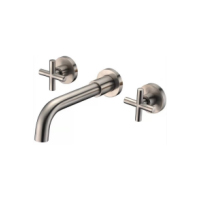
The most useful way to set wall faucet height is to decide where the stream should hit inside the sink.
A stable, low-splash stream usually lands:
Near the center of the drain line but not directly on the drain opening
Around the back half of the bowl, not near the front rim
Far enough from the wall to keep hands comfortable under the spout
If the stream lands too close to the front edge, water often splashes out. If it lands too close to the wall, users wash hands against the back of the basin and create mess.
Installers typically measure wall mounted faucet height from the finished countertop or finished sink rim up to the spout outlet.
In many residential bathroom setups, a common range is:
About 4 to 6 inches above the sink rim for many standard basins
About 6 to 8 inches above the sink rim for deeper bowls or higher-arc spouts
Higher placements may be used for vessel sinks, but only when the spout reach and bowl depth prevent splashing
These ranges are not rules. They are starting points. The correct final height depends on sink geometry and faucet design.
To avoid guessing, measure based on finished surfaces and the faucet spout outlet.
Confirm the finished sink rim height
Use the final installed position, not the rough-in stage.
Identify the faucet spout outlet point
The outlet is where water leaves the spout, not where the faucet body sits.
Determine the desired clearance for handwashing
Most users prefer enough space for hands and soap without hitting the spout.
Check bowl depth and slope
Deeper bowls can allow slightly higher spout outlets with less splash.
Mark the expected water landing point
The goal is a stream that lands into the bowl with minimal splash and comfortable reach.
When these measurements are done before tiling or wall finishing, the faucet height becomes predictable.
These sinks usually have moderate depth and a rim close to the countertop. The faucet outlet height often works best when it supports hand clearance without creating splash from a long falling stream.
A moderate outlet height above the rim is typically easiest to live with.
Vessel sinks are higher above the countertop and often have steeper sides. They need careful matching between spout reach and outlet height.
If the spout is too high relative to the bowl, the water hits with more force and splashes. If reach is too short, the stream lands near the wall side and causes mess.
Shallow basins require more attention to splash control. A lower outlet height and a controlled aerator stream usually reduce splashing.
A wall mounted faucet can be placed at a reasonable height but still perform poorly if reach is wrong.
Short reach often forces the stream to land near the back of the basin
Excessive reach can push the stream too close to the front edge
Correct reach places the stream near the drain line without hitting the drain directly
Height and reach should be selected together. A good match improves comfort and reduces cleaning workload.
The table below helps connect common sink scenarios with practical mounting goals.
| Sink scenario | Common user goal | Height approach | Key note |
|---|---|---|---|
| Standard bathroom basin | Comfortable handwashing, low splash | Moderate outlet height above rim | Stream should land near drain line |
| Deep bowl basin | More clearance for washing | Slightly higher outlet height | Bowl depth helps reduce splash |
| Vessel sink | Modern look with stable stream | Height based on vessel rim and reach | Reach must land stream inside bowl center |
| Shallow basin | Minimize splash | Lower outlet height and controlled flow | Avoid long falling stream |
This table should be used together with the faucet specification and the real sink dimensions.
When the spout is high, the falling stream gains speed and splashes more. This often causes water around the rim and countertop, even with normal handwashing.
When the stream hits the drain opening directly, splash increases and noise becomes louder. It also causes uneven wear marks in some finishes over long use.
Tile thickness, backer board, and waterproof layers change the final faucet depth and can affect how the spout aligns with the basin. Always measure from finished surfaces rather than rough framing.
A wall mounted faucet must match basin depth, basin position, and user habits. Choosing a faucet without confirming reach and outlet position often leads to rework.
Wall mounted faucets require stable construction and dependable operation because corrections after installation are more difficult than with deck-mounted faucets. FUJIA focuses on products designed for practical daily use and reliable installation outcomes.
FUJIA provides a range of wall mounted basin faucets suitable for modern bathroom projects where users expect clean design, stable water flow, and comfortable washing space. Matching spout design to basin geometry helps reduce splashing and improves long-term user experience.
There is no universal single number because sinks and faucets vary. The most reliable method is to position the faucet so the stream lands inside the basin near the drain line with comfortable hand clearance.
It can be installed higher, but the spout reach and the bowl depth must prevent splashing. Height alone does not solve vessel sink performance.
Center alignment is common, but stream landing point matters more. A centered faucet with the wrong reach can still land water too far forward or too far back.
A wall mounted faucet is typically installed so the spout outlet sits several inches above the sink rim, but the correct height depends on basin depth, spout reach, and where the stream lands inside the bowl. The best installation is the one that keeps splashing low, provides comfortable hand clearance, and places the stream near the drain line without hitting it directly.
For projects that need stable performance and a clean modern look, FUJIA offers reliable wall mounted basin faucets designed to match common bathroom layouts and support practical everyday use.
 Mobile Phone:
 Contact Now