

Wall mounted faucets are not a bad idea by default. They can be an excellent choice for modern bathrooms, hospitality projects, and high-cleanliness spaces because they free up countertop area and simplify wipe-down cleaning around the sink. However, they do require better planning than deck-mounted faucets. Most negative opinions come from avoidable issues such as incorrect rough-in height, mismatched spout reach, poor access planning, or low-quality in-wall components.
This article explains when wall mounted faucets work well, where they can create problems, how to reduce risk during design and installation, and what to look for when sourcing. Where product selection matters, FUJIA offers durable wall mounted basin faucets designed for stable daily performance and project-friendly installation outcomes.
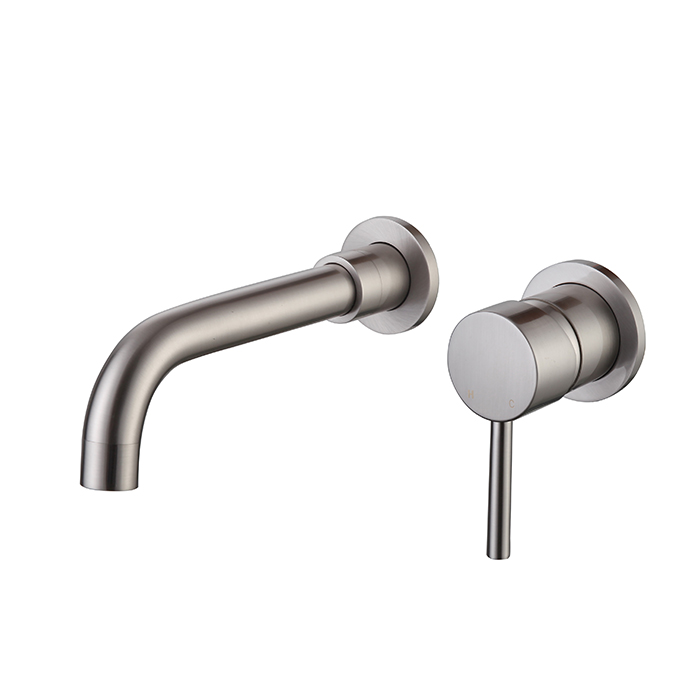
Many complaints are not about the concept. They are about execution. The most common problems happen when wall mounted faucets are installed without matching the faucet geometry to the sink and without planning service access.
Splashing occurs when the water stream falls too far or hits the wrong part of the basin. This is often caused by:
Spout outlet set too high above the sink rim
Spout reach too short, pushing the stream toward the back wall
Spout reach too long, landing the stream too close to the front edge
Aerator flow that is too aggressive for a shallow basin
When the spout height and reach are selected correctly, splashing can be reduced significantly.
A common fear is that leaks or cartridge replacement will require opening the wall. That risk depends heavily on how the system is designed.
In most quality wall mounted setups:
The cartridge or service parts are accessible from the front
The rough-in body is installed with correct sealing and pressure testing
The wall is waterproofed correctly around the installation
Repair becomes difficult mainly when low-quality in-wall valves are used or when access is not planned.
Wall mounted faucets require accurate rough-in positioning. If the finished wall thickness, tile layers, and sink location are not finalized, the faucet can end up misaligned. This increases installation time and the chance of rework.
Deck-mounted faucets can be swapped more easily. Wall mounted faucets are less forgiving because the rough-in position is inside the wall. This is why choosing a reliable product and confirming geometry early matters.
Wall mounted faucets often outperform deck-mounted faucets in certain environments.
By removing faucet hardware from the deck, you reduce the number of surfaces that collect water spots and soap residue. This is especially valuable in:
Hotels and serviced apartments
Commercial restrooms with high cleaning frequency
Compact vanities where every inch of counter space matters
Wall mounted faucets create a streamlined appearance because the sink deck stays visually clean. Designers often choose them for minimalist bathrooms and premium projects.
With the right spout reach and height, wall mounted faucets can pair well with vessel sinks because they place the spout outlet at an ideal position without requiring tall deck-mounted bodies.
The key is selecting faucet geometry that directs the stream to the correct landing zone inside the bowl.
They are not ideal for every project. The decision depends on project constraints.
Quick replacements with unknown wall plumbing layout
If you are renovating and cannot confidently control rough-in position, a deck-mounted faucet may be simpler.
Walls with limited depth or complicated structure
Some walls cannot accommodate the required plumbing layout without significant modification.
Projects without reliable waterproofing control
Poor waterproofing is a risk for any plumbing fixture, but wall mounted systems require careful finishing at the penetration points.
Users who frequently change fixtures
If the homeowner expects easy swapping between faucet styles, deck-mounted may be more flexible.
The best way to judge wall mounted faucets is to look at how well a project controls geometry, quality, and service planning.
A wall mounted faucet should place the stream near the drain line, but not directly on the drain opening. When reach is correct, the sink is more comfortable to use and easier to keep dry.
Lowering the outlet too much can reduce hand clearance, while raising it too much increases splash. A balanced outlet height is the difference between a clean bathroom and a daily wipe-down problem.
Good product design typically allows service from the front. This reduces the fear of wall demolition. Buyers should confirm:
Cartridge accessibility
Standard service parts availability
Clear installation documentation and tolerances
Wall mounted installations are not the place to cut corners on quality. Stable construction reduces risk of leaks, loosening, and performance drift.
| Comparison point | Wall mounted faucet | Deck-mounted faucet |
|---|---|---|
| Countertop cleaning | Easier because deck is open | Harder due to base and crevices |
| Space on vanity | More available space | Less available space |
| Installation planning | Requires accurate rough-in | More forgiving |
| Flexibility after install | Lower | Higher |
| Splash control | Depends strongly on reach and height | Often easier to predict |
| Repair access | Good if front-service design is used | Typically straightforward |
This comparison shows why wall mounted faucets are not a bad idea, but they are a better fit for projects that control design and installation details.
Wall mounted faucets succeed when the product is designed for stable daily use and when the installation outcome is predictable. FUJIA focuses on durable construction, practical geometry, and project-friendly performance.
FUJIA provides a range of wall mounted basin faucets suitable for residential and commercial bathrooms where buyers value clean aesthetics, stable water flow, and easier countertop maintenance. Choosing a reliable faucet helps reduce the long-term concerns commonly associated with wall mounted installations.
They do not inherently leak more. Leakage risk depends on product quality, sealing design, correct installation, and pressure testing. A properly installed wall mounted faucet with reliable components can perform as reliably as a deck-mounted faucet.
They require more planning because rough-in location matters. Once the wall layout is controlled, installation is straightforward for experienced installers.
They can be easy to service if the design allows front access to the cartridge and service components. The biggest risk is choosing a system that does not support accessible maintenance.
Wall mounted faucets are not a bad idea. They are a high-value choice when the project prioritizes easy countertop cleaning, modern design, and optimized sink space. The main risks come from incorrect height and reach matching, lack of service planning, and poor quality in-wall components.
If you want a wall mounted solution designed for stable daily use and predictable project results, FUJIA offers reliable wall mounted basin faucets that support modern bathroom layouts and long-term performance.
 Mobile Phone:
 Contact Now