

Yes, most pull-out residential kitchen faucets swivel. In fact, swivel rotation is one of the main reasons homeowners choose this style, because it lets the spout move across a wider working area while the pull-out hose extends to reach corners, cookware, and even nearby countertop zones. The swivel function and the pull-out function work together, but they are not the same feature. Swivel describes how the spout rotates around its base. Pull-out describes how the spray head extends on a flexible hose.
This article explains how swivel works on pull-out kitchen faucets, what swivel ranges you can expect, what limits swivel in real installations, and how to choose a pull-out faucet that stays smooth and stable over long-term use. FUJIA manufactures pull-out kitchen faucets designed for consistent rotation, reliable hose movement, and durable daily performance. View the product range here: pull-out kitchen faucet.
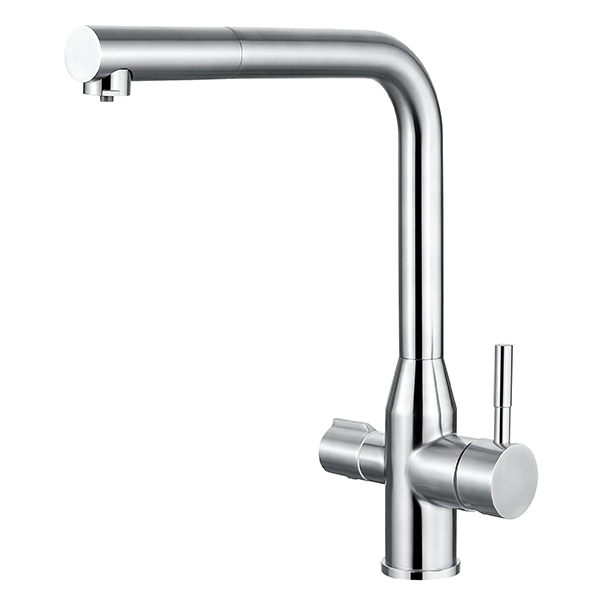
A pull-out kitchen faucet typically swivels through the spout body at the base. Internally, the faucet uses a rotating joint that allows the spout to turn left and right while maintaining a sealed water path. The turning motion is supported by internal bearing surfaces and sealing rings. When the faucet is built and assembled correctly, the spout rotation feels smooth, controlled, and stable with no wobble.
A typical swivel structure includes:
A rotating spout body mounted on a fixed base
Sealing rings that prevent leakage while allowing rotation
Bearing or guided surfaces that control smooth turning
Waterway components designed to avoid pinching during rotation
A mounting system that keeps the faucet stable on the sink deck
In daily use, you may not notice the engineering details, but you will notice whether the faucet turns smoothly and stays aligned after thousands of rotations.
Not all pull-out faucets swivel to the same angle. Some are designed for compact sinks and rotate less. Others target wider sinks and allow broader swing. The swivel range influences whether you can comfortably use the faucet for two-bowl sinks, wide farmhouse sinks, or sink-plus-counter workflows.
Typical swivel ranges you will see in residential pull-out faucets:
120° to 150° swivel
Often used for compact kitchens where full rotation could hit walls or backsplashes.
180° swivel
Common for standard single-bowl sinks where left-right reach is needed but space is limited.
360° swivel
Useful for island sinks and open layouts where the spout needs full rotation without obstruction.
A wider swivel range is not automatically better. If the faucet is installed near a wall, a full 360° swivel can cause the spout to hit the backsplash, which becomes an annoyance rather than a benefit.
Many buyers assume swivel is purely a product feature, but the installation environment often determines how usable the swivel range actually is.
Common swivel limits include:
Backsplash clearance
If the faucet is close to a wall, the spout may contact the backsplash before reaching full rotation.
Sink hole placement
Faucet holes near corners reduce usable swing because the spout hits side walls or accessories.
Cabinet constraints below the sink
While swivel happens above the deck, hose routing below can create resistance if the hose catches on stored items or plumbing.
Handle clearance
Some pull-out faucets have side handles. If the handle hits a wall or window trim, it can limit movement.
Add-on accessories
Soap dispensers, filtration taps, and sink racks can restrict spout rotation if spacing is tight.
A practical evaluation is to measure the distance from the faucet centerline to the nearest wall or obstacle and consider whether the spout arc can rotate without contact.
Pull-out faucets are popular because they combine two reach methods.
Swivel moves the spout body to reposition the working zone
Pull-out extends the spray head to reach areas beyond the spout’s normal arc
In a compact kitchen, this combination is very efficient. You can swivel to align with a pot, then pull out to rinse the pot wall and corners. You can also pull out to fill a container placed near the sink edge while using swivel to avoid awkward hose angles.
However, the best experience depends on how smoothly both motions work together. A well-designed faucet will allow:
Smooth swivel movement without tightening when the hose is extended
Stable docking even after repeated pull-outs and rotations
Controlled hose length that does not twist excessively during swivel
If the hose is too short or the internal routing is not optimized, swivel can feel stiff when the spray head is extended.
Swivel performance is not only about initial feel. The real question is whether the rotation stays smooth after repeated use, cleaning, and daily kitchen activity.
Key indicators of durable swivel performance include:
Stable base mounting that prevents spout wobble
A faucet that shifts on the sink deck will feel unstable during swivel.
Consistent turning resistance
The spout should not feel loose in one direction and tight in another.
No grinding or stick-slip sensation
Rough feel can indicate poor internal guiding or contamination during assembly.
Leak resistance at the rotating joint
Seals must remain stable under rotation and pressure cycling.
Hose routing that does not bind
If the hose catches below the sink, swivel becomes harder and users may force the spout, accelerating wear.
A simple field test is to swivel the spout repeatedly with the spray head docked and then again with the spray head extended. The resistance should remain controlled in both conditions.
Swivel range matters more in certain kitchen layouts.
High importance cases:
Double-bowl sinks
You need enough swing to position the spout over both bowls without forcing angles.
Wide single-bowl sinks
A wider sink requires broader reach to access all corners.
Island sinks
Full rotation is more usable because there is usually no wall obstruction.
Sink adjacent to prep area
Swivel helps position water over the sink and nearby rinse zones, while pull-out extends reach.
Lower importance cases:
Very narrow sinks
Pull-out reach often matters more than swivel range.
Wall-mounted faucets or tight backsplash placement
Physical obstructions can limit usable swivel regardless of rated angle.
Matching swivel range to the actual installation environment prevents buying a high-rotation faucet that cannot use its full range.
FUJIA manufactures pull-out kitchen faucets with attention to real household usage patterns: frequent rotation, repeated pull-out cycles, and continuous water pressure changes. For consistent user experience, the rotating joint must stay smooth while maintaining sealing reliability. FUJIA focuses on stable component matching, controlled assembly quality, and durable finishing so swivel motion remains consistent and the spout stays aligned over long service cycles.
For a distributor sourcing reliable models for repeat orders, stable specifications and repeatable performance across production batches reduce installation variability and support long-term customer satisfaction. View the product range here: pull-out kitchen faucet.
Most pull-out residential kitchen faucets swivel, and swivel rotation is a core feature that works together with the pull-out hose to expand reach and improve sink workflow. The usable swivel range depends on the faucet design and the kitchen environment, including wall clearance, sink hole placement, and under-sink hose routing. By selecting a pull-out faucet with an appropriate swivel range and ensuring proper installation space, you can achieve smooth rotation, stable docking, and efficient daily operation.
 Mobile Phone:
 Contact Now