

Concealed and exposed shower faucets deliver the same core function: controlling water temperature and flow for a shower system. The difference is where the working parts are located and how the installation interacts with the wall. A concealed shower faucet hides the valve body and plumbing inside the wall, leaving only the trim visible. An exposed shower faucet keeps the mixing body and most components outside the wall, mounted on the surface. This choice affects appearance, installation complexity, maintenance access, renovation cost, and how the shower space feels day to day.
This guide explains the real differences, when each type makes the most sense, what to evaluate before choosing, and how to avoid common project mistakes. FUJIA supplies both system styles to match different bathroom layouts and construction conditions. Explore: exposed shower faucet and concealed shower set.
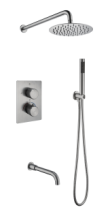
The most important difference is the valve location.
A concealed shower set places the mixing valve and connection points inside the wall. Only the control handle, trim plate, and outlet components are visible. Because the valve is hidden, the wall must be opened during installation or renovation, and the valve depth must be positioned correctly.
A typical concealed installation involves:
Setting the valve body depth to match finished wall thickness
Routing hot and cold lines inside the wall
Pressure testing before wall closure
Installing waterproofing, tile, or panel finish
Mounting trim and outlets after finishing
An exposed shower faucet mounts the mixing body externally. Hot and cold connections are typically visible or covered by minimal decorative components. This makes installation easier when you do not want to open the wall, and it simplifies retrofits.
A typical exposed installation involves:
Aligning hot/cold supply points to the faucet spacing
Mounting the faucet body to the wall surface
Connecting outlets such as hand shower or riser rail
Sealing penetrations and verifying stability
If the bathroom is already finished and you want to avoid wall work, exposed systems often reduce time, mess, and renovation risk.
Bathroom design trends often drive the concealed vs exposed decision. Concealed shower sets create a clean wall with minimal visible hardware, which can make the shower area feel larger and more premium. Only the trim, handle, and shower outlets are visible, so the wall looks simpler and easier to style.
Exposed shower faucets show the main body outside the wall. This creates a more functional, mechanical look. In some design styles, that is a benefit. It can also make the system feel more accessible and straightforward to users.
Practical space and style differences:
Concealed systems reduce visual clutter and support minimalist interiors
Exposed systems are more visually prominent but can suit industrial or classic utility styling
Concealed walls are easier to wipe clean because there are fewer external parts
Exposed systems have more external surfaces, but they can be cleaned easily with direct access
If the project goal is a clean, modern finish with strong architectural lines, concealed is often preferred. If the goal is practical upgrade without major wall work, exposed often wins.
Maintenance is where the concealed vs exposed decision becomes highly practical.
Exposed shower faucets offer direct access to most components. If you need to replace a cartridge, check seals, or diagnose a leak, the working parts are usually reachable without opening the wall. This is one reason exposed systems are popular for quick renovations and rental properties where service access matters.
Concealed systems hide the valve body, so service access depends on trim design and internal valve structure. Most well-designed concealed sets allow cartridge access from the front by removing the handle and trim plate, but major plumbing repairs behind the valve still require wall access.
A helpful way to think about maintenance:
Routine servicing such as cartridge replacement can often be done from the front on concealed systems
Any pipe or fitting leak behind the wall is more disruptive for concealed systems
Exposed systems reduce risk because all connections are visible and accessible
For hospitality or multi-unit properties, the maintenance strategy should be decided early. Some projects choose concealed for the premium look and accept the need for controlled installation standards. Others choose exposed to minimize future service disruption.
Concealed installations demand stronger control over build quality because the valve and connections are in a wet-area wall. Waterproofing integrity and pressure testing become critical steps. Any error becomes harder to fix after finishing.
Key concealed requirements:
Correct valve depth and alignment before wall closure
Reliable waterproofing around penetrations
Full pressure test and leak check before tile or panel installation
Correct sealing of trim plate to prevent water ingress into the wall cavity
Exposed systems still require sealing at penetrations, but they generally carry less risk because the main body is outside the wall. If a connection weeps slightly, it is visible and can be addressed early.
For new builds and high-end renovations, concealed systems can perform excellently when installation standards are enforced. For fast remodels or uncertain wall conditions, exposed systems often offer more predictable outcomes.
Both concealed and exposed systems can deliver excellent shower performance when engineered well. The difference is how the user experiences the system and how the outlets are configured.
Concealed shower sets often support:
Cleaner control ergonomics with a simple handle and trim
Flexible outlet combinations such as overhead shower, hand shower, and spout
A more integrated look where outlets appear intentionally placed
Exposed shower faucets often support:
Simple operation with the mixing body and diverter in one visible unit
Easier upgrades where you replace the entire faucet without wall work
Straightforward layout for compact bathrooms and retrofit situations
The user experience also depends on how the diverter is designed and how smoothly the handle controls temperature. That is a product-quality issue more than a concealed vs exposed issue. For a consistent shower feel, focus on cartridge stability, smooth control range, and reliable switching between outlets.
The product price is only part of the cost. The installation method changes labor time, wall finishing work, and risk of rework.
Cost drivers for concealed systems:
Opening the wall and rebuilding the finish
Waterproofing and tiling labor
Setting correct valve depth and alignment
Higher consequences if leak testing is not done correctly
Cost drivers for exposed systems:
Matching existing pipe spacing and wall conditions
Visible pipe routing if supply points are not aligned
Limited ability to hide uneven walls without additional work
For renovation projects, exposed systems often provide a faster path to upgrade. For new construction or major remodels, concealed systems often provide a stronger design result when the project schedule includes proper rough-in and testing.
A practical selection method is to match the system to your construction conditions and your priorities.
Choose a concealed shower set when:
You are building new or doing a full renovation with wall access
You want a clean, minimalist bathroom appearance
You plan a multi-outlet shower layout with integrated styling
You can control installation standards and pressure testing
Choose an exposed shower faucet when:
You want a faster installation with minimal wall demolition
The project is a retrofit or upgrade in a finished bathroom
You prefer easy future servicing without opening walls
You need a practical solution for rental or high-turnover properties
If you are sourcing for a project buyer, the decision often comes down to installation consistency and future service strategy rather than appearance alone.
FUJIA supplies both concealed and exposed shower systems so projects can match the right installation method to the bathroom build condition. For new builds that want a clean finish, FUJIA concealed shower sets support modern wall-integrated styling. For renovations and rapid upgrades, FUJIA exposed shower faucets provide straightforward installation and easy access for long-term servicing.
For OEM/ODM programs, stable specifications and consistent production help maintain uniform quality across multiple bathrooms in a project. Explore the ranges here: exposed shower faucet and concealed shower set.
The difference between concealed and exposed shower faucets is mainly where the valve body and connections sit. Concealed systems hide working parts inside the wall for a minimalist look, but they require precise rough-in, reliable waterproofing, and controlled installation. Exposed systems keep the main body outside the wall, making installation and servicing easier, especially for retrofits.
If you choose the system based on wall access, maintenance strategy, and design goals, both concealed and exposed shower faucets can deliver a stable, comfortable shower experience with long service life.
 Mobile Phone:
 Contact Now