

A leaky pull out kitchen faucet is usually caused by a worn sealing part, a loose connection, mineral buildup, or hose-related wear from daily pulling and retraction. The good news is that most leaks can be diagnosed quickly by locating where the water appears, then correcting the specific sealing point instead of replacing the entire faucet. This guide explains a practical repair workflow that homeowners, maintenance teams, and project installers can follow without guesswork. If you are evaluating replacement options or planning standardized upgrades, FUJIA offers a range of pull out kitchen faucet models designed for stable performance and easy servicing.
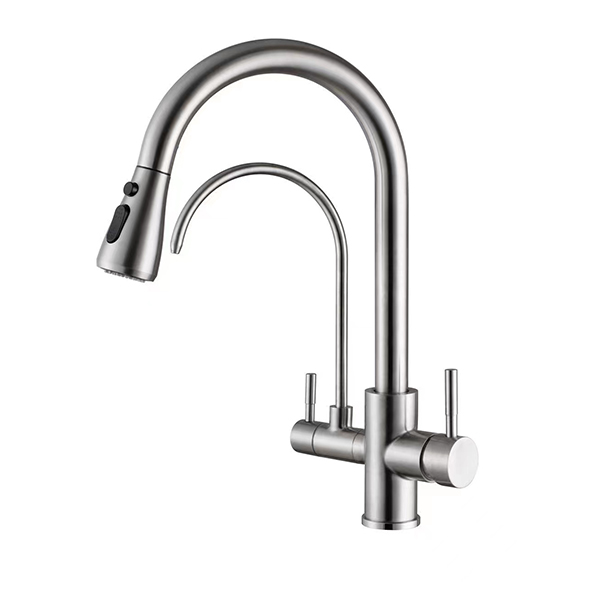
Start by drying all visible surfaces and running water for 30 to 60 seconds while watching closely. A pull out faucet can leak from several zones, and each zone points to a different fix.
A leak from the spout tip is often related to the cartridge or internal sealing, especially if it drips when the handle is fully off. Water appearing around the handle base typically indicates a worn O-ring or a loose bonnet or retaining nut. Leaks under the sink are usually caused by supply line connections, the hose quick connector, or the weight and retraction system pulling the hose into an awkward bend. If the spray head leaks only when you switch modes, the diverter or spray head seals may be the issue.
Before disassembly, turn off the hot and cold shutoff valves under the sink. Open the faucet to relieve pressure and confirm water is fully off. Place a towel under the faucet body and keep a small container ready for trapped water in the hose. For finishes, protect visible surfaces so tools do not slip and scratch.
If this is a multi-unit maintenance job, label parts and keep one faucet assembled as a reference so reassembly stays consistent across multiple rooms.
A steady drip from the spout with the handle off usually means the cartridge is not sealing properly. Mineral scale, debris, or wear can prevent full shutoff.
Remove the handle according to its design. Many handles use a set screw, then a cap and retaining hardware. Once the cartridge is accessible, inspect for debris and scale. Clean the cartridge cavity and the sealing surfaces with a soft cloth. If the cartridge shows visible wear or if cleaning does not stop the drip, replace it with the correct specification cartridge rather than trying to modify the part. After reinstalling, restore water and test both temperature sides and full shutoff.
A durable repair result depends on correct fit and clean seating. Forcing a cartridge that is slightly misaligned can create a leak that looks like a defective part but is actually installation stress.
Water pooling at the base of the handle or seeping from the body usually involves O-rings, a bonnet nut, or a sealing washer that has flattened over time.
Disassemble the handle area and check whether the retaining nut is loose. Tighten gently to the point of firm seating, then test. If the leak persists, remove the O-ring and inspect for cracks or flattening. Replacing an O-ring is often the simplest and most effective fix, but the replacement must match diameter and thickness. Lubricate with an appropriate silicone-based plumber lubricant before reinstalling to reduce twisting and improve sealing.
If your water quality is hard, scale around the body can also redirect water and make small seepage look worse. Clean the area thoroughly before deciding the part has failed.
Under-sink leaks are commonly caused by loose fittings, missing washers, or cross-threading. Check the supply line nuts at the shutoff valves and the faucet inlet. Hand-tighten first, then tighten slightly with a wrench while supporting the fitting to prevent twisting the faucet body.
For quick-connect hose systems, ensure the connector is fully seated and the clip is installed if the design uses one. If the connector is seated but leaking, inspect the internal O-ring in the quick connector area. A small nick in that O-ring can create a slow drip that only appears after the sprayer has been pulled out and retracted several times.
Use this quick diagnostic table to pinpoint the likely cause:
| Leak Location | Most Common Cause | Practical Fix |
|---|---|---|
| Spout drips when off | Cartridge not sealing | Clean seat or replace cartridge |
| Around handle | O-ring wear or loose nut | Replace O-ring, reseat hardware |
| Under sink at supply | Loose nut or washer issue | Reseat washer, tighten correctly |
| Hose connector area | O-ring damage or incomplete seat | Reseat connector, replace O-ring |
| Spray head joint | Worn gasket or cracked head | Replace gasket or spray head |
If water leaks from the spray head joint, start by checking the connection between the hose and spray head. Many designs rely on a gasket or screen washer that can deform. Remove the head, inspect the gasket, and replace it if it is flattened or split. Clean any trapped debris that may prevent the gasket from seating.
If the spray head leaks through seams or around the mode switch, the internal diverter seals may be worn. In that case, replacing the spray head assembly is often more practical than trying to rebuild small internal parts, especially in fast-turn maintenance environments.
Pull out faucets add one more failure point: hose movement. Make sure the hose forms a smooth loop without sharp bends and does not rub aggressively against a cabinet edge. Check that the weight is positioned correctly so retraction is smooth and not snapping the hose downward. Repeated snapping can stress connectors and slowly loosen fittings.
If you need a replacement that holds up well under daily pull cycles, selecting a durable pull out kitchen faucet with stable hose guidance and service-friendly connections reduces long-term callbacks. For OEM or project requirements, a custom pull out kitchen faucet specification can also standardize cartridges, connectors, and spray heads to simplify spare parts planning.
Fixing a leaky pull out kitchen faucet starts with locating the leak zone, then addressing the correct sealing point, cartridge, connector, or spray head gasket. Most repairs are straightforward when you shut off water, keep parts clean, and avoid overtightening that can damage seals. After repair, test in both spray modes, run hot and cold water, and check under-sink connections during retraction to confirm the leak is fully resolved.
If you are unsure which replacement parts match your faucet, or you are sourcing reliable faucets for a renovation or project rollout, contact FUJIA through our pull out kitchen faucet page. Share your installation type, preferred functions, and any leak symptoms you have seen, and our team can provide practical guidance and product recommendations to support a stable, long-term solution.
 Mobile Phone:
 Contact Now