

A faucet does not need to be replaced according to a fixed calendar. Some faucets continue working well for many years, while others develop leaks, corrosion, unstable handles, or internal wear much earlier.
The decision should be based on the faucet’s condition, repair history, water quality, installation, and availability of replacement parts. A faucet that still operates smoothly and remains free from leaks may not need replacement simply because it is old.
However, repeated repairs can become less economical than installing a new unit.
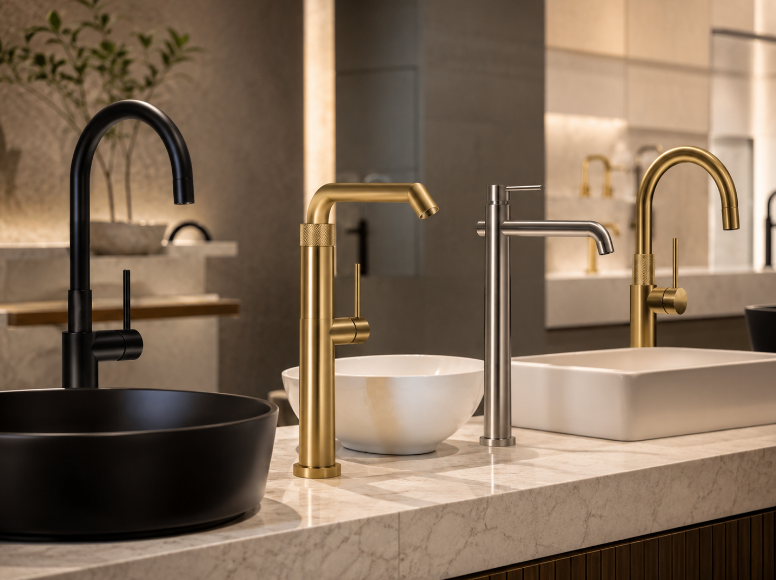
Many residential faucets remain in service for approximately 10 to 20 years, but this is only a general planning range.
Actual service life can be shorter or longer depending on:
Body material
Cartridge quality
Water pressure
Water hardness
Installation accuracy
Cleaning products
Frequency of use
Surface finish
Availability of spare parts
Indoor environmental conditions
A lightly used guest-bathroom faucet may last longer than a kitchen faucet operated dozens of times each day.
An occasional drip does not always mean the complete faucet has failed.
Worn cartridges, O-rings, washers, aerators, and supply hoses can often be replaced. Repair is usually practical when the faucet body remains stable and the correct parts are available.
Replacement becomes more reasonable when:
The faucet leaks again soon after repair
More than one internal component is worn
The body has developed a crack
The valve seat is damaged
Water appears around several connection points
The faucet cannot close smoothly
Spare parts are no longer available
Repeated service calls can eventually cost more than a suitable replacement.
Faucet surfaces are exposed to water, soap, cleaning products, minerals, and frequent hand contact.
White deposits may simply be hard-water residue, while peeling plating, rough pits, green discoloration, or cracks may indicate more serious deterioration.
A small scratch or faded finish does not necessarily affect water control.
Structural concerns include:
Corrosion around threaded connections
Cracks near the spout or base
Movement between the faucet and sink
Damage around the cartridge chamber
Persistent leakage beneath the counter
Severe corrosion inside the waterway
When the faucet body itself is damaged, replacing only the cartridge will not solve the problem.
Low flow is often caused by a blocked aerator, supply-line restriction, or mineral buildup.
Begin by removing and cleaning the aerator. Check whether the hot and cold supply valves are fully open and whether the flexible hoses are bent.
If flow remains weak after cleaning and the internal waterway is heavily restricted, replacement may be more practical.
A faucet should allow predictable adjustment between hot and cold water.
Replacement or cartridge service may be required when:
Water temperature changes suddenly
The handle is difficult to control
Hot and cold positions are reversed
The cartridge makes unusual noise
The handle moves without changing the flow
The plumbing system should also be inspected because temperature problems do not always originate inside the faucet.
A faucet may still function but no longer suit the updated sink, countertop, or kitchen workflow.
Replacement may be useful when the new installation requires:
Greater spout height
Longer spout reach
Pull-down spray function
Additional spray modes
Filtered-water outlet
Different mounting-hole arrangement
Coordinated sink and faucet finish
Easier access for large cookware
A faucet should be selected for the sink dimensions rather than appearance alone.
Hard water can leave mineral deposits around aerators, cartridges, spray heads, and handle bases.
Sediment can also enter moving components and interfere with sealing.
Routine cleaning and water filtration may reduce buildup, but strong acidic cleaners can damage decorative finishes.
For routine maintenance:
Wipe the faucet with a soft damp cloth.
Use mild neutral detergent when required.
Rinse away cleaner residue.
Dry the surface after cleaning.
Avoid steel wool and abrasive pads.
Do not leave acidic cleaner on the finish.
The correct method depends on whether the faucet is brushed, polished, matte, plated, or PVD finished.
Repair is generally reasonable when:
The faucet body is structurally sound
The finish remains acceptable
The problem is limited to one cartridge or seal
The required part is available
The mounting remains stable
The faucet still matches the sink
The repair cost is proportionate
Replacing every dripping faucet creates unnecessary cost and waste when a simple service part can restore normal operation.
Hotels, apartments, restaurants, hospitals, and public buildings should evaluate faucets through a maintenance plan rather than waiting for complete failure.
Useful records include:
| Maintenance Item | What to Record |
|---|---|
| Installation date | Helps estimate service age |
| Leak history | Reveals repeated failures |
| Cartridge replacements | Shows internal wear frequency |
| Finish condition | Supports room-renovation planning |
| Water-pressure issues | Identifies system-wide stress |
| Spare-parts availability | Determines repair practicality |
| User complaints | Highlights flow or operation problems |
Replacing faucets in planned batches can reduce room downtime and create a more consistent appearance.
A well-made Stainless Steel kitchen faucet can provide a strong body, a clean modern appearance, and practical maintenance for residential and commercial kitchens.
Buyers should still confirm the complete specification, including:
Stainless steel grade
Cartridge type
Aerator
Supply hoses
Mounting system
Spout rotation
Spray-head structure
Surface finish
Pressure testing
Replacement parts
The body material alone does not determine the performance of the complete faucet.
We supply single-handle, pull-down, pull-out, waterfall, and drinking-water kitchen faucets, together with basin faucets, shower faucets, sinks, and bathroom accessories.
Our team supports customized materials, finishes, cartridges, aerators, logos, connection standards, and packaging. Buyers can coordinate the faucet with the sink and related sanitary products for renovation or repeat purchasing.
Send us the existing sink dimensions, mounting holes, spout height, required reach, spray functions, finish, connection standard, packaging, and purchasing quantity.
We will prepare a Stainless Steel Kitchen Faucet proposal suitable for replacement, renovation, or private-label supply.
Previous: What Faucets Are in Style Now?
 Mobile Phone:
 Contact Now