

Plumbers do not all prefer one faucet brand or one visual style.
Most are more concerned with whether the faucet fits the installation, seals correctly, can be serviced later, and uses components that are easy to identify.
A beautiful faucet can create problems when the connections are unusual, the mounting hardware is difficult to reach, or replacement cartridges are unavailable.
The faucets plumbers tend to appreciate are practical before they are decorative.
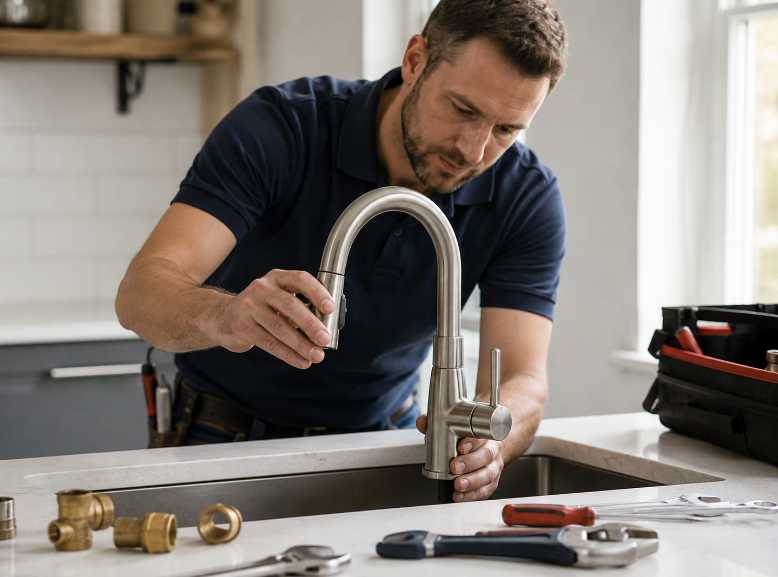
A faucet should match the local water-supply connections and sink preparation.
Plumbers normally check:
Hot and cold connection size
Supply-hose length
Number of mounting holes
Mounting-hole diameter
Countertop thickness
Available space below the sink
Spout reach
Drain or accessory arrangement
Standardized parts reduce the need for adapters and make future repairs easier.
Every additional joint creates another possible leak point.
A clear hose arrangement, suitable seals, and accessible fittings make installation more straightforward.
The connection should still allow the plumber to tighten the fitting without twisting the pipe or hose.
The cartridge controls water flow and temperature.
Even a strong faucet body can become inconvenient when the cartridge cannot be removed or identified.
Plumbers generally prefer faucets with:
Common cartridge dimensions
Accessible retaining parts
Clear hot and cold orientation
Available replacement cartridges
Stable handle operation
Reliable ceramic sealing surfaces
Suitable pressure range
A cartridge should be replaceable without removing the complete faucet whenever possible.
Faucet bodies may be made from brass, stainless steel, or other engineered materials.
Plumbers often prefer products with a stable body, accurate threads, and dependable connections rather than thin or poorly finished castings.
Brass is widely used for valve bodies because it can be machined accurately and supports different surface finishes.
The exact alloy and waterway specification should match the target market.
Stainless steel can provide a clean appearance and useful corrosion resistance.
For kitchen applications, buyers should confirm the steel grade, wall thickness, welding quality, and finish.
The material name alone does not explain the complete product quality.
A faucet must remain stable on the sink or countertop.
Plumbers value mounting hardware that:
Is easy to reach
Fits different countertop thicknesses
Holds the faucet firmly
Does not rotate during use
Includes the correct washers
Can be tightened with normal tools
Does not damage the sink surface
A poorly supported tall faucet may loosen when the user repeatedly moves the spout or spray head.
Aerators collect mineral deposits and small particles over time.
An external or removable aerator allows the plumber or user to clean the outlet without replacing the complete spout.
Useful features include:
Standard aerator thread
Easy removal
Replacement availability
Controlled flow rate
Stable stream pattern
Anti-limescale nozzles
Matching removal key for recessed models
An unusual hidden aerator can make a simple maintenance task more difficult.
A Pull Down Kitchen Faucet is useful when the hose moves freely and returns smoothly.
The cabinet below the sink must provide enough space for the hose and counterweight.
A practical system includes:
Clearly marked quick connection
Flexible hose with suitable length
Secure spray-head connection
Correctly positioned counterweight
Smooth hose path
Replaceable spray head
No interference from waste pipes or storage items
The hose should not rub against sharp cabinet edges or become trapped around valves.
Complex features can be useful, but every additional valve, electronic module, spray outlet, or filter connection adds maintenance requirements.
For rental properties, apartments, hotels, and high-volume commercial projects, a simpler design may reduce service time.
That does not mean the faucet must be basic. It means the features should justify the additional components.
A faucet should operate within the building’s available water pressure.
High pressure can stress cartridges, seals, hoses, and connections. Low pressure may reduce the performance of spray functions or multifunctional outlets.
Before selecting the faucet, confirm:
Minimum operating pressure
Maximum operating pressure
Required flow rate
Local water-saving limits
Hot-water temperature
Pipe condition
Filter or heater restrictions
The faucet cannot correct an unsuitable plumbing system on its own.
A plumber may be able to repair a ten-year-old faucet quickly when the cartridge, aerator, spray head, and hose remain available.
A newer faucet with unidentified internal parts may require complete replacement after one small failure.
Project buyers should request a spare-parts list covering:
| Component | Why It May Need Replacement |
|---|---|
| Cartridge | Wear or mineral damage |
| Aerator | Blockage or flow change |
| Supply hose | Age or connection damage |
| Pull-down hose | Repeated movement |
| Spray head | Button or nozzle wear |
| O-rings | Leakage |
| Mounting kit | Relocation or repair |
| Handle screw | Loss during servicing |
Keeping a small spare-parts stock can reduce room or kitchen downtime.
Installation becomes more difficult when a faucet has:
Unclear instructions
Nonstandard threads
Short supply hoses
Weak mounting plates
Hidden connections
No cartridge identification
Fragile plastic fittings
Poorly finished threads
Inaccessible retaining nuts
No after-sales parts
A low purchase price may be offset by longer installation time and future service problems.
Before approving a large order, install a sample on the actual sink or countertop.
The test should include:
Mounting stability
Hot and cold connection
Handle movement
Spout rotation
Spray-head operation
Hose return
Flow pattern
Leakage inspection
Cleaning response
Cartridge access
Feedback from installers can identify practical problems that are not visible in product photographs.
Our kitchen faucet range includes single-handle, pull-down, pull-out, waterfall, and drinking-water models in stainless steel and brass configurations.
Buyers can specify connection standards, hose lengths, cartridges, aerators, spray functions, spout rotation, finishes, logos, and packaging.
We also supply matching sinks, basin faucets, shower faucets, angle valves, bib cocks, and bathroom accessories for coordinated purchasing.
Send us the sink dimensions, mounting-hole size, countertop thickness, water connections, required hose reach, spray modes, cartridge, aerator, finish, packaging, and quantity.
We will prepare a Pull Down Kitchen Faucet proposal for sample installation and technical review.
Previous: How To Attach Hose To Faucet?
 Mobile Phone:
 Contact Now